
Which Kaysville Public Records Are Open
Kaysville records do not sit in one database. City departments retain municipal files, Davis County keeps land, tax, marriage, and many archival collections, and Utah agencies publish court and license data. GRAMA begins with a right to inspect records classified as public, yet another law or a privacy classification can limit a specific file. This coverage chart leads with the practical custodian and all verified access routes.
| Record Set | Custodian | Online Index | Access |
|---|---|---|---|
| Deeds, liens, plats | Davis County Recorder | Property Search; REDI-Web | Free index, paid images, terminal, or copies |
| Parcel and tax roll | Recorder, Assessor, Treasurer | Property Search 2.0 | Free informational search or office help |
| District and justice cases | Utah Courts and filing clerk | Xchange; most district courts complete by end 1998 | Paid web, free terminal, or clerk request |
| Birth and death | Davis Health and Utah OVRS | No open current person index | Eligible requester with ID; Archives when old |
| Marriage and divorce | Davis Clerk; court or OVRS | No verified marriage index; Xchange case summary | County, court, state product, or Archives |
| City permits and licenses | Kaysville departments | No verified historic name index | Department, online form, PDF, state portal, or GRAMA |
| Police reports | Kaysville Police | Dedicated request form | ID, classification, and posted fees apply |
| Custody and registry | Davis Sheriff; Utah Corrections | Separate jail, offender, and registry tools | Published fields; verify status and date |
Voter data has its own product and privacy rules, so the detailed field split belongs with the Kaysville voter registration lookup. Business entities and professional licenses are statewide searches rather than city files. None of these indexes overrides sealed-case rules, vital-certificate eligibility, or identity-data protections.
Note: Kaysville is not the county seat; Farmington is the physical hub for most Davis County records and court files.
Davis Recorder Access for Kaysville
The Davis County Recorder records and indexes deeds, mortgages, liens, plats, notices, and other real-property instruments for Kaysville parcels. Its preserved record trail reaches back to the county era, with an early book collection dated to 1870 and modernization through computerization and microfilm beginning in 1981. Online coverage is layered, so no single start year can safely describe every scanned image or abstract.
Staff assist patrons with locating records and parcels on ownership plats. They also provide document, plat, and certified copies. They do not perform title searches, prepare forms, interpret legal instruments, or give legal descriptions by phone. Public terminals and counter service are available weekdays from 8 a.m. to 5 p.m. The Recorder property-search launch page shows the owner, address, parcel, and entry-number routes:
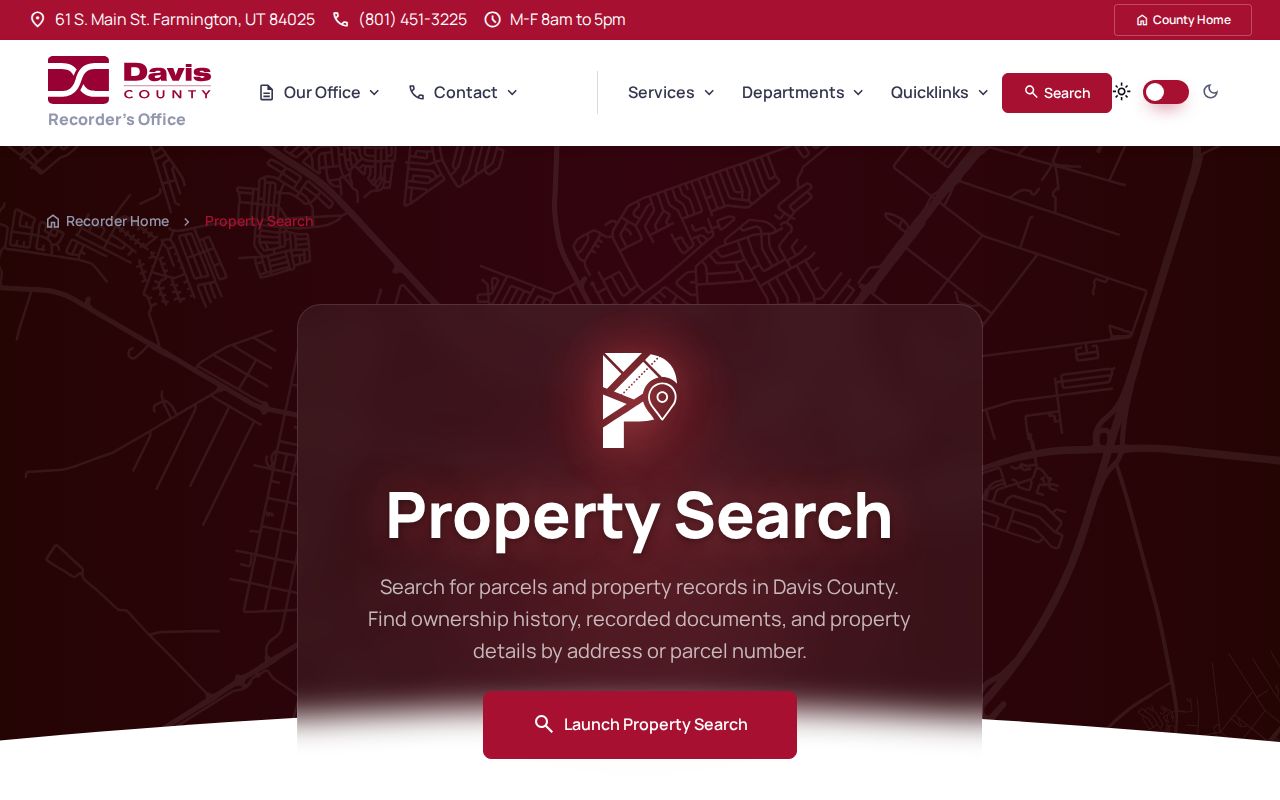
The launch screen is the public doorway, while the recorder counter remains the fallback for older books, copies, and records that are not exposed online.
Search Kaysville Property Records
Davis County Property Search 2.0 joins recorder, assessor, map, and tax clues. Use an owner name, a Kaysville street address, a parcel or serial number, or a document entry number. The county instructions say to include the city when typing an address. Select the autocomplete result, click the parcel, and save the parcel ID before moving to linked tax or deed information.
| Search control | Input | Use | Format note |
|---|---|---|---|
| Owner Name | Text or search mode | Find ownership records | Optional |
| Property Address | Autocomplete text | Open a mapped parcel | Include Kaysville |
| Parcel / Serial Number | Text | Use the durable property ID | Tax search omits dashes |
| Document Entry Number | Text or search mode | Locate a recorded instrument | Direct placement |
| Map parcel | Interactive click | Reveal parcel details | Zoom until parcel lines show |
| Tax Information | Link | Open the linked tax roll | Payments update daily after receipt |
A parcel card may show owner and tax-mailing details, situs address, legal description, boundary, values, characteristics, and a Primary or Secondary tax classification. Situs means the physical property location. Mailing means the tax-notice destination. Neither alone proves where a named person now lives.
Free Property Watch can alert a bona fide owner when listed deeds, mortgages, liens, judgments, or finance statements are recorded against a parcel. It is a forward-looking alert, not a title search, and it ends when title changes.
The live Property Search 2.0 interface illustrates the map-centered route:
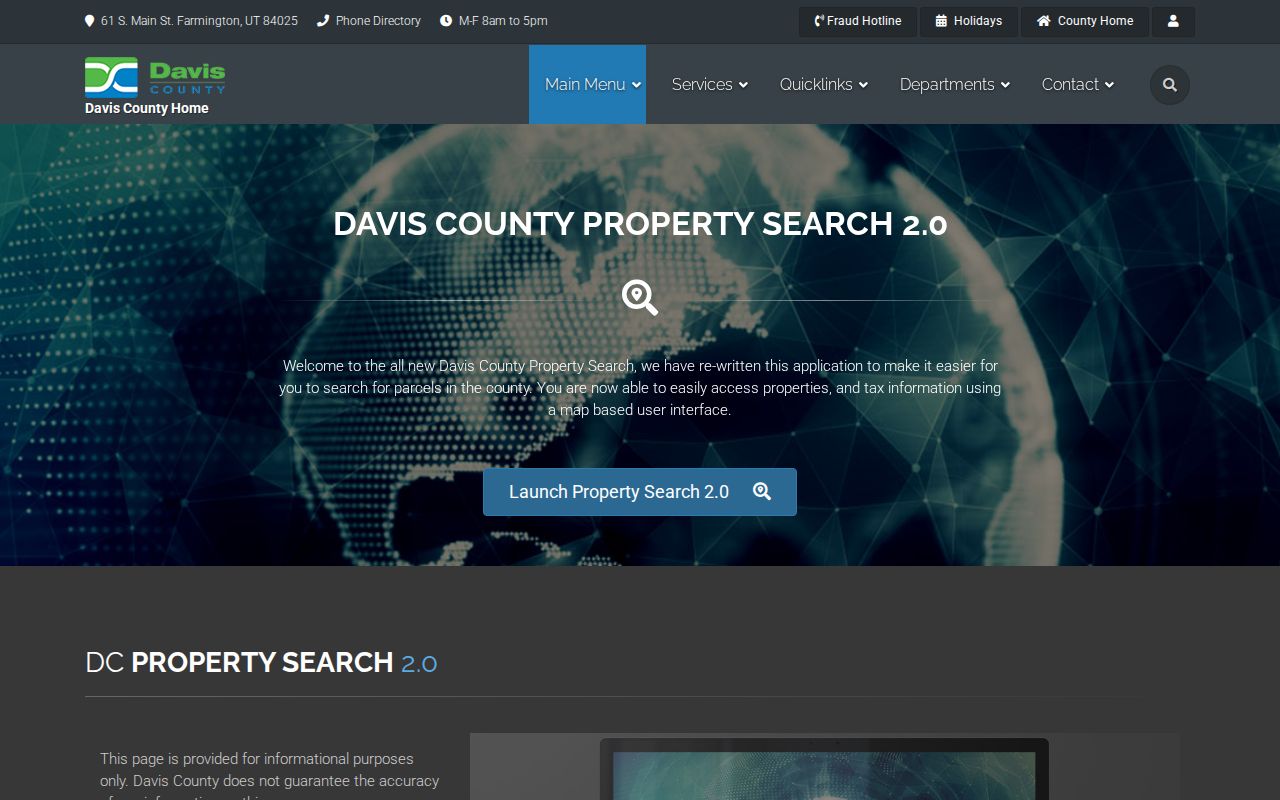
Parcel boundaries and the serial number help connect a current map result with deed, assessment, and tax material without treating a mailing address as proof of occupancy.
Insider tip. Type the city with the street address, then copy the parcel ID before following tax and recorded-document links.
Kaysville Records: Free or Paid
The free parcel portal is best for current ownership, parcel placement, values, and linked tax data. REDI-Web is the recorder's deeper subscription route for abstracts, images, and advanced document modes. Its help supports document searches by entry number, party name, book/page, development, or location and parcel searches by serial number, owner name, or situs address. The serial-number route is recommended.
Current REDI-Web terms list a $50 connection charge, then $15 per month without images or $25 with images. Transactions include a $0.50 abstract, $1 printer-friendly abstract, $0.10 document image, $0.25 tie sheet, and $1 plat, survey, township-reference, or survey-index product. At the counter, document and computer printouts cost $2 per page; a certified copy costs $5 plus $2 per page.
- Index
- A finding aid that points to a record; it may not include the document image.
- Abstract
- A parcel summary linking ownership and recorded entries; it is not a title opinion.
- Certified copy
- An official copy authenticated by the custodian for formal use.
- Custodian
- The agency that maintains the requested record and decides access under law.
- Exemption
- A statute or classification that withholds all or part of a record.
Note: The recorder accepts no phone-in orders, and a $10 minimum purchase applies at its office.
Kaysville Court Records and Xchange
Kaysville matters can appear in the Second Judicial District or Kaysville Justice Court, depending on jurisdiction. Utah Xchange searches public district and justice CORIS data. It can return party names, available addresses, judge, attorneys, filings, hearings, judgments, and outcome. Most district-court data is complete by the end of 1998, while justice-court conversion dates vary. The search allows district court, justice court, or both; all cases or judgments only; case number; last name or company; first name; case type; statewide, county, or court scope; birth date; citation details; and date ranges. Use an asterisk wildcard with a first name, then narrow common names by county, court, type, or date. Results cap at 500.
The official Xchange gateway also explains access and exclusions:
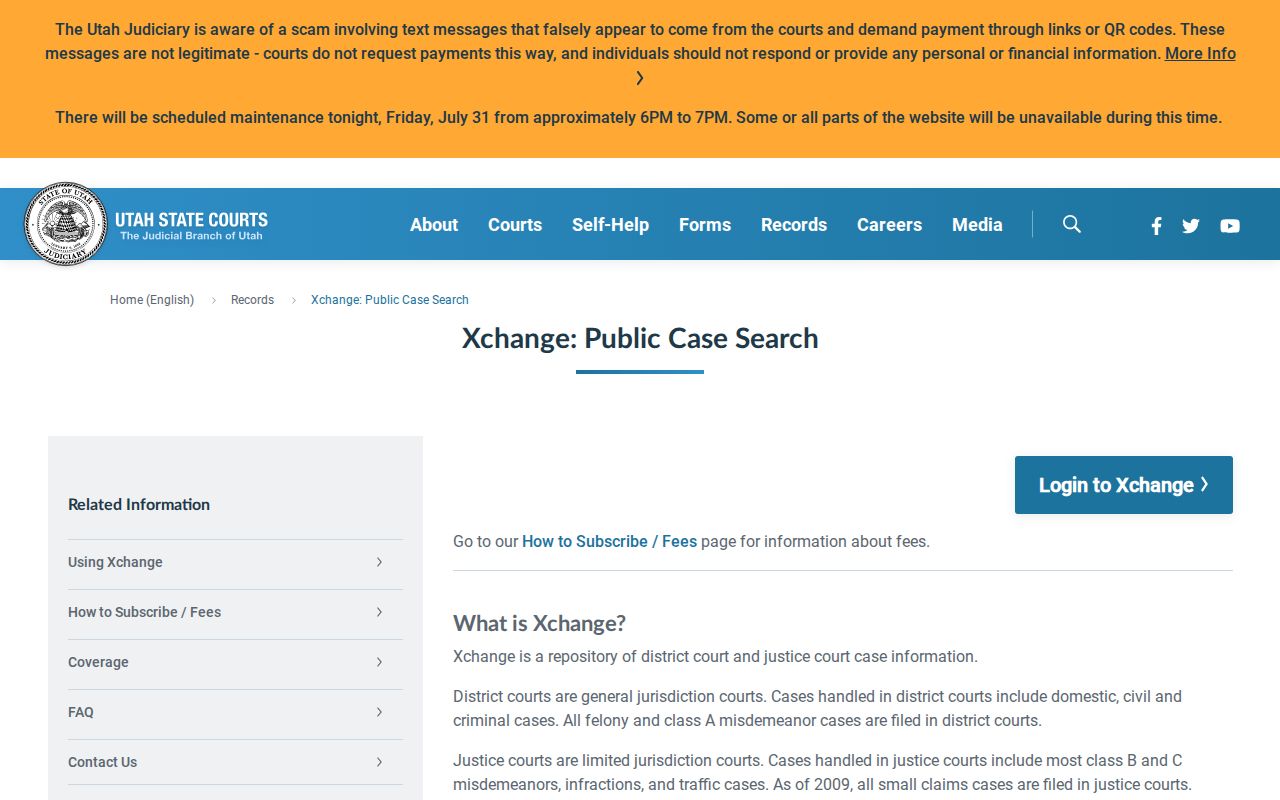
Web searches and document access can be billable. Free Xchange terminals are available at most district courthouses and the Utah State Law Library, while the filing clerk supplies actual files, corrections, copies, certifications, and audio requests.
Do not mistake a hit for guilt. A listed person may be a plaintiff, heir, creditor, petitioner, or dismissed defendant. Read the role, disposition, and document context.
Kaysville Vital Records Boundaries
Current birth and death certificates are controlled records, not an open name database. The Davis County Health Department vital-records desk and Utah Office of Vital Records and Statistics issue qualifying copies. Applicants provide event facts, identity, relationship or legal authority, acceptable ID, contact details, a signature, and the required fee.
Marriage licenses for Davis County events belong with the Davis County Clerk. Divorce decrees and full case files remain with the court, even when the state offers a verification product. Utah Archives generally receives birth records after 100 years and death records after 50 years. Under Utah Code §26B-8-125(5), marriage, divorce, and other vital records use a 75-year public-release period, subject to the series and its actual cutoff.
The county certificate page is the local issuance route:
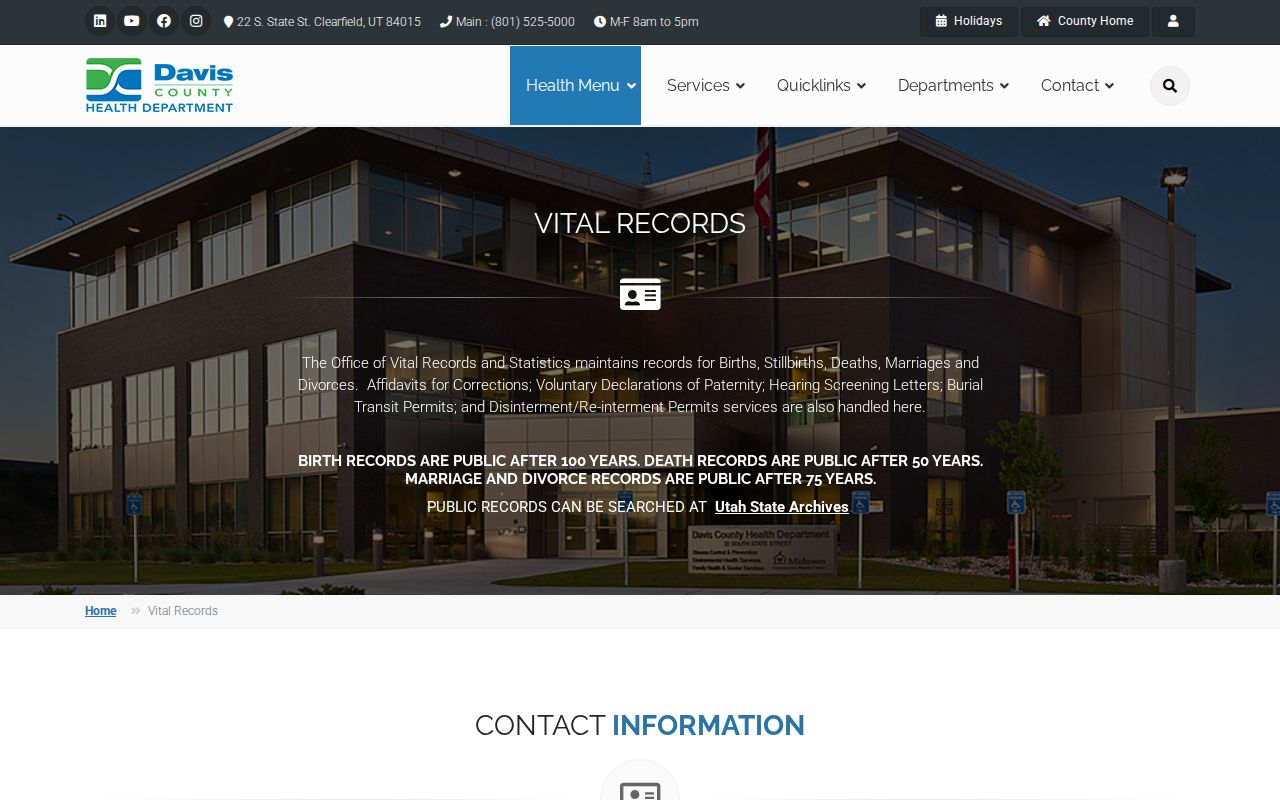
Online, mail, and in-person channels can have different delivery charges or wait times. For statewide mail service, a completed form, fee, and valid ID go to Vital Records, PO Box 141012, Salt Lake City, UT 84114-1012.
Kaysville Public Records Offices
Municipal and county channels should not be mixed. The Kaysville Legal Department centrally processes ordinary city requests, while police uses a dedicated form. Land files belong with the Davis County Recorder in Farmington. Court clerks control case files, and health offices control current certificates.
Davis County Recorder
61 S Main, Suite 106
Farmington, UT 84025
801-451-3225
Utah Courts
Second District and Kaysville Justice Court
Clerk for the filing court
Davis County Vital Records
Davis County Health Department
Local qualifying certificates
For other Davis County material, the Clerk's routing page sends birth and death requests to Health, marriage requests to the Clerk, property questions to Property Records, delinquent tax matters to Tax Administration, and divorces to District Court. Remaining county requests use the county's NextRequest portal or GRAMA manager.
Kaysville City and Police Fees
Kaysville's city form asks for the person or department holding the file and a reasonably specific description. A requester may choose inspection, copies with an authorized dollar ceiling, or a fee-waiver request. It also collects contact details, the basis for access to nonpublic material, any expedited reason, a signature, and a date. Requests can use the city online form, the PDF, or the Utah Open Records Portal.
Ordinary city research, compilation, and editing include the first 15 minutes at no charge. Later work is billed at the hourly rate of the lowest-paid qualified employee in 15-minute increments. Posted city items include $0.25 paper copies, $1 per email or attachment, $30 per 500 email subject-line results, and a $10 flash drive. Prepayment may be required.
Kaysville Police records use a separate web request and require valid government photo ID to receive a report. The police schedule lists $10 reports, $15 photos, $50 for each body-camera video, and $15 for a 911 call, with added labor after 30 minutes. Prepared records are held for 30 days.
Custody lookups are separate. The Davis County jail channel covers local custody, the Utah Corrections search covers state offenders, and the Utah Sex and Kidnap Offender Registry publishes registry data under its disclaimer. A booking is not a conviction, and each status should be checked against its displayed date.
Note: A requester acting for another person should attach the notarized release requested by the Kaysville Legal Department.
Kaysville Permit Records and Plans
Kaysville building permits can be public and may identify a contractor, engineer, or architect. No verified historic permit-name index was found, so the access chain begins with the Building Department at 801-544-1363, followed by an address-specific GRAMA request for an existing permit file.
A city notice published in April 2026 draws a firm line between a permit and proprietary plans. Copies of the plans need written or emailed permission from the proprietary party. Without permission, the plans may be inspected during a 45-minute Building Department appointment, but no photo, copy, or device is allowed. Handwritten notes are permitted.
When Kaysville Records Are Offline
No verified public name index was found for current Davis County marriages, historical Kaysville permits, or city business licenses. Start with the responsible desk, identify an existing record or list, and request inspection or a copy. For county collections, the Davis County Records Catalog is an ArchivesSpace inventory. It describes series, dates, formats, and contents, but it is not a digitized-record viewer.
Older court files may have moved to the Utah State Archives after about 50 years. Justice-court records from before CORIS may remain only with the office or Archives. Land researchers can use the recorder's terminals and historic books. When a portal gives only an identifier, save the case, parcel, entry, book/page, party, and date before asking the counter for the exact file.
Three access levels often coexist: free web index, paid image or abstract, and in-person terminal or paper file. That split is why “online” does not mean complete for Kaysville. Each layer answers a different question.
Closed and Restricted Utah Records
GRAMA classifies records as public, private, controlled, protected, or exempt under another statute. Sealed and expunged cases, juvenile records, adoptions, some family and civil pleadings, current vital certificates outside eligibility, military discharge access, and active-investigation or victim data can be limited. Driver information remains restricted by the federal Driver's Privacy Protection Act and Utah law.
Redaction can protect Social Security numbers, government ID numbers, account data, and other private fields while leaving a public portion available. Utah's Consumer Privacy Act can give rights against qualifying commercial controllers, but it does not erase government records governed by retention and access law. Historical deeds and court files also do not vanish because a later mailing address changes.
Use any released address or identity detail only for lawful personal research. Utah stalking and electronic-communication harassment laws can apply when location or contact data is used for threats, surveillance, or repeated unwanted contact.
Request Kaysville Public Records
Utah's Government Records Access and Management Act, Utah Code Title 63G, Chapter 2, applies to identifiable records kept by a governmental entity. It does not require an agency to answer research questions, create a new compilation, or obtain another custodian's file. A written request should provide the requester's name, mailing address, daytime phone, an email if electronic delivery is acceptable, and a reasonably specific description.
- Choose the custodian. Send a city permit to Kaysville, a deed to Davis County Recorder, or a case document to the filing court.
- Check published access. Search the relevant portal and capture exact parcel, case, entry, or date details.
- Describe an existing record. State the subject, date range, office, record type, and preferred electronic format. Add a fee cap when useful.
- Select inspection or copies. Inspection is generally free, though segregation or programming may still carry a lawful charge.
- Track the response. The ordinary deadline is no later than 10 business days. The agency may provide access, deny with a basis, identify another custodian, or cite extraordinary circumstances and an estimated date.
Qualifying expedited requests that primarily benefit the public may use a five-business-day timetable if accepted. Fees cannot exceed actual cost, and staff time cannot exceed the lowest-paid qualified employee's rate. Inspection and usually the first 15 staff minutes are free. Prepayment may be required when an estimate exceeds $50 or a prior bill remains unpaid.
Appeal a Kaysville Records Decision
A denial should identify the record classification, legal basis, and appeal procedure. Silence at the statutory deadline is treated as a denial. A requester generally has 30 days to appeal a denial or fee-waiver decision to the agency's chief administrative officer under Utah Code §63G-2-401.
The chief administrative officer generally has 10 business days to decide, or five for a qualifying expedited matter. After an affirmance, current Utah law allows routes involving the Government Records Office director, district court, mediation, or an established local appeals board. A narrower request can also help when volume, legal review, redaction, clustered requests, or programming caused delay.
Keep the original request, delivery proof, fee estimate, response, cited statutes, and all dates together. Those items show exactly what was sought and preserve the record for review.